
Your Home Could Have Its Own AI. Here Is What That Actually Looks Like.

You have probably seen the Iron Man films. Tony Stark walks into a room and just talks to his house. Jarvis, dim the lights. Jarvis, what is the reactor status. Jarvis, lock everything down.
Most people assume that is science fiction. Something for 2045, maybe.
It is not. A properly set up Home Assistant home can get surprisingly close to that today, and in ways many mainstream smart home ecosystems still struggle to replicate. Not Google Home. Not Apple HomeKit. Not Amazon Alexa. If you are comparing platform trade-offs in detail, this Home Assistant vs Tuya guide for Singapore homeowners is a useful companion.
This article is not a technical guide. It is an honest look at what is actually possible when AI meets Home Assistant, written for Singapore homeowners who are curious but not technical.
If you want the technical breakdown on LLM implementation trade-offs, prompts, and guardrails, read our deeper guide: What LLMs Can Actually Do for a Home Assistant Smart Home.
Quick Answer
- Yes, Home Assistant can work with Claude, OpenAI, and Gemini for natural language control.
- The practical upgrade is context-aware control, where one sentence can trigger multiple actions.
- If you want higher privacy, local LLM setups are possible, but they need dedicated hardware.
- The advanced version is an AI butler flow where you can message your home through Telegram.
What Makes Home Assistant Different from Other Smart Home Platforms
Most smart home platforms are closed systems. They do what the manufacturer designed them to do, and nothing more. If the manufacturer does not support a feature, you simply do not get it.
Home Assistant is open. It connects with almost anything, can be configured to behave almost any way you want, and grows whenever something new comes along. This is why it is the platform of choice for people who take their smart homes seriously, and why, when AI became genuinely useful in everyday life, Home Assistant became one of the most practical smart home platforms where people could actually put it to work.
If you are still figuring out which platform to build your home on, understanding this distinction matters a lot. You can read more in our Singapore smart home platform guide.
The Usual Way: Voice Assistants in Smart Homes
Most people with a smart home and a voice assistant, Google, Alexa, Siri, have some level of integration. You say "Hey Google, turn off the living room lights" and it works. If you want a deeper practical comparison, we covered this in our voice control guide for Home Assistant in Singapore.
But it is rigid.
For home control you have to say the right thing in the right way. Phrase it slightly differently and it either does the wrong thing or nothing at all, because it is matching your words to a fairly fixed set of command patterns rather than working out what you actually meant.
Home Assistant integrates with Google Assistant too, and it works for basic commands. But the rigidity remains. You are still working around the system rather than with it.
The Better Way: Real AI Connected to Your Home
What changes things significantly is connecting a proper AI, Claude, OpenAI, or Gemini, directly to Home Assistant's built-in voice assistant, called HA Assist.
The difference is not subtle.
Instead of rigid command matching, you get genuine understanding. You can say things like:
"It feels stuffy in here, can you do something about it."
"We are having people over tonight, set the mood."
"I am heading to bed, sort out the house."
A real AI understands context, infers what you mean, and acts accordingly. It can ask a clarifying question if it needs to. It handles multi-step requests in a single sentence. It behaves as though you are talking to someone who genuinely understands your home, not issuing commands to a machine that needs exact syntax.
This is the version of voice control people imagined smart homes would have. It just took connecting the right AI to the right platform to get there. And Home Assistant is where that connection happens most effectively today.
For HDB and condo homeowners in Singapore thinking about voice control, this is a meaningful upgrade over what most integrators currently offer.
The Advanced Option: Running Your Own AI at Home
For homeowners who want to take things further, there is the option of running an AI model entirely within your own home network with no cloud, no third-party servers, and no subscription.
This is called a local LLM (local large language model). The AI lives on a dedicated machine in your home, processes everything locally, and keeps your conversations and home data completely private.
The trade-off is hardware. Running a capable AI locally requires a dedicated computer with its own graphics processing unit. It is not something you plug in and forget. The AI models available for local use are also generally less capable than the leading cloud models like Claude or GPT-4.
But the technology exists today and people are actively using it with Home Assistant. For families who are serious about keeping their home data in-house, particularly those aligned with a local-first smart home philosophy, this option is worth knowing about. If data ownership is your main concern, read this breakdown on smart home data privacy and ownership.
What We Have Been Building: An AI Butler for Your Home
This is where things get interesting, and where we want to share something we have been quietly developing for select clients.
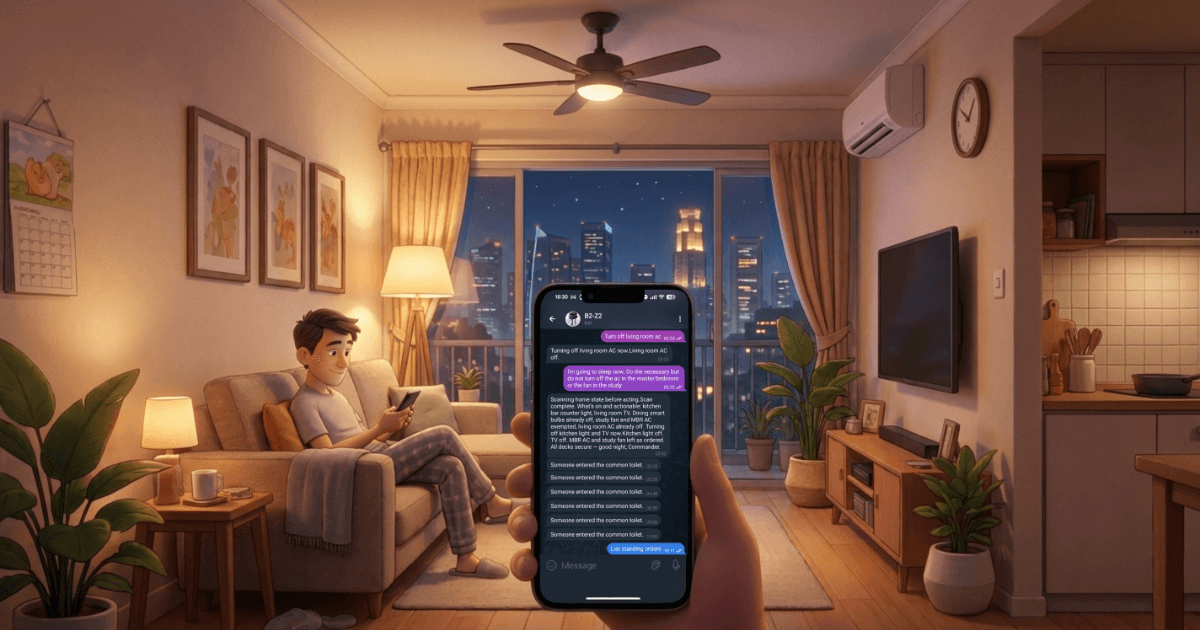
Beyond connecting AI to voice control, we have been building something more personal: a dedicated AI butler that lives inside your Home Assistant setup, runs around the clock, and is accessible to you through Telegram from anywhere in the world.
Here is what that looks like in practice.
You are at work and want to check whether you left the air-con on. You open Telegram and message your home. It replies immediately with the current status of every device you care about.
You are on holiday and want the lights to come on at a specific time tonight. You send a message. Done.
You come home and something feels off. You ask your home what happened while you were away. It tells you.
It is not a dashboard to navigate. It is not a list of automations to remember. It is a conversation with something that knows your home, has access to everything in it, and can act on your behalf immediately. Think of it as a housekeeper who is always home, always informed, and always reachable, except this one does not need days off. If you still want visual control as a fallback, this guide on custom Home Assistant floorplan dashboards shows what that can look like.
What makes our approach different
A version of this is technically something anyone with a paid AI subscription could attempt to build. The problem is cost. AI conversations use processing credits every time the model thinks, reasons, and responds. A poorly designed AI butler racks up costs very quickly, making it impractical for most households regardless of how technically capable the builder is. This is the same pattern we often see in broader hidden costs of Home Assistant projects.
What we have spent considerable time solving is efficiency. Our AI butler is engineered to use the minimum AI processing necessary while remaining genuinely useful and responsive. The goal, and we are close to it, is something a normal Singapore household can run indefinitely without the cost becoming a concern.
This is still in active development. We are making it available to select clients as we refine it. We mention it here not to sell something, but because it represents what becomes possible when you combine deep Home Assistant knowledge with a clear understanding of how AI actually works at a practical level.
This level of integration is still rare in the market. We think that matters, especially if you are comparing options for your home.
How Close Is the Jarvis Vision, Really?
Closer than most people think.
- Natural language voice control that actually understands you: Available now, via HA Assist with Claude or OpenAI.
- A home that responds to context rather than commands: Available now.
- An AI that knows your home, watches over it, and is reachable from anywhere: Being built and deployed now, for select clients.
- A home that proactively manages itself with minimal input: Still ahead of us, but the gap is closing faster on Home Assistant than anywhere else.
If you have looked at your smart home lately and felt like it should be doing more, you are probably right. The capability exists. It just needs to be set up properly, by people who understand both the platform and the AI layer on top of it.
FAQs
Can Home Assistant work with AI like ChatGPT or Claude?
Yes. Home Assistant integrates with OpenAI, Claude (Anthropic), and Gemini. This lets you control your home using natural language instead of rigid commands, so you can say things like "I'm heading to bed, sort the house out" and the system understands what you mean.
What is the difference between Google Assistant in a smart home and real AI?
Google Assistant is built around short, structured commands, so for home control you have to phrase things its way and it struggles with anything multi-step. A real AI like Claude or GPT understands context and intent, so you do not need to say commands in a specific way, and it can handle multi-step requests in a single sentence.
Can you run AI locally in Home Assistant without the cloud?
Yes, using a local LLM (large language model) like Ollama. This keeps home data on your own network with no cloud dependency, but requires dedicated hardware with a GPU to run properly.
What is an AI butler for a smart home?
An AI butler is a persistent AI assistant connected to your smart home that you can message anytime, from anywhere, to check your home's status or issue commands. Think of it like texting a housekeeper who is always home and always has eyes on everything.
Thinking about adding AI to your Home Assistant setup?
We help Singapore homeowners plan practical AI integrations, from natural voice control to advanced Home Assistant workflows that fit real daily life.
Talk to us about your home