
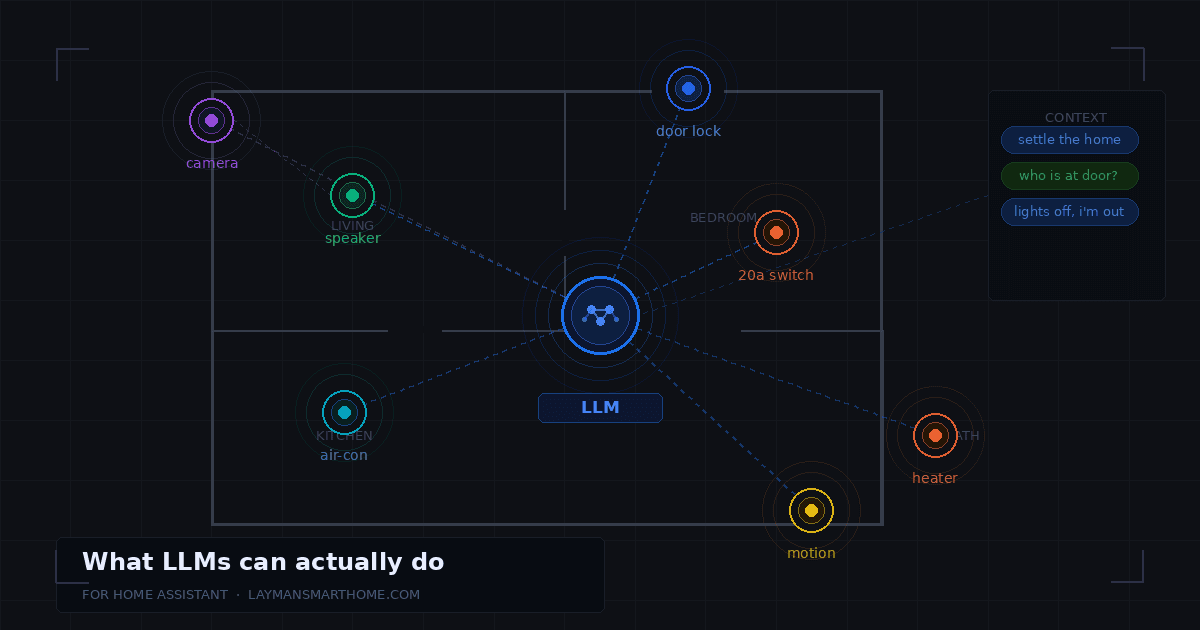
What LLMs Can Actually Do for a Home Assistant Smart Home

If you have watched movies like Iron Man, you already know the fantasy: a house that does not just follow commands, but actually understands what is happening and helps manage the place in real time.
For a long time, smart homes were nowhere near that. Even good ones were still quite rigid. You had to tap the right button, say the exact command, or build an automation rule for every little thing.
That is why LLMs are such a big deal in Home Assistant.
Used properly, they can make your smart home feel less like a control panel and more like a home manager. Not magic, not a robot butler with a physical body, but something much closer to natural help than what most people imagine when they hear "smart home".
If you are looking for a homeowner-focused walkthrough of what this feels like in daily life, including AI butler use cases and Telegram control, read Your Home Could Have Its Own AI. Here Is What That Actually Looks Like..
Quick Answer
- LLMs let you talk to Home Assistant in natural language ("settle the house for the night, but keep the study on") instead of issuing one rigid command at a time.
- A practical example already in use: doorbell snapshots get an AI description ("looks like a delivery") instead of a vague "motion detected" alert.
- LLMs can also act as a setup assistant, reviewing YAML, spotting weak automation logic, and suggesting improvements.
- Cloud LLMs are easier to set up but come with cloud dependency and possible cost; local LLMs protect privacy but add setup complexity and hardware cost. Get your core automations stable first before adding this layer.
The Big Shift: From Commands to Context
Traditional smart homes are good at fixed logic.
If motion is detected after 7pm, turn on the hallway light.
If the temperature goes above 27C, start the air-con.
That still works, and it is still the foundation of a solid Home Assistant setup. But an LLM adds something different: context.
Instead of forcing you to think like a machine, it gives the system a better shot at understanding what you mean in normal language.
That matters because normal people do not speak in automation syntax. They say things like:
- "I am going to sleep soon, help me settle the house."
- "Can you check if I left anything on outside?"
- "Who is at the door, and should I care?"
This is where Home Assistant starts to feel far more intelligent.
A Real Example: Smarter Door Alerts
The most basic LLM setup we currently run is around the doorbell camera, and even this already shows why the technology is useful.
The flow today is straightforward:
- Someone loiters near the door.
- The doorbell camera captures a snapshot.
- The LLM describes what it sees.
- A phone notification is sent with the image and description.
- Home speakers can announce that description inside the house.
That is very different from a normal motion alert.
Instead of a vague notification that just says motion detected, you get something closer to actual information. For example, whether it looks like a delivery person, someone waiting outside, or just a neighbour passing by.
For normal homeowners, this is where the value becomes obvious. The smart home is no longer only detecting activity. It is helping you interpret what is happening.
The Interesting Part: Talking to Your Home Naturally
This is the part that gets people excited.
With the right setup, an LLM-connected Home Assistant system can handle more natural, multi-step interactions instead of making you issue one rigid command at a time.
Rather than saying:
- turn off the living room lights
- set the bedroom air-con to 24
- arm the night mode
you could say something more normal, like:
"I am done for the night. Please settle everything but keep the study on because I still have work to finish later."
That kind of interaction is powerful because it matches how people actually think. The homeowner focuses on intent, and the system translates that into actions.
This is also why LLMs can make Home Assistant feel less intimidating to family members who are not interested in dashboards, scenes, or automation menus. If the system can understand natural phrasing, the barrier to using the home drops a lot.
LLMs Are Not Only for Voice Control
Most people first imagine voice assistants, but that is not the whole story.
One underrated use is treating the LLM like an assistant for the Home Assistant system itself.
If configured properly, it can help review YAML, spot weak logic, point out errors, suggest cleaner best practices, and even propose automations that fit the way you live. For homeowners who already have a decent Home Assistant setup, this can be a serious shortcut.
Instead of staring at pages of configuration and wondering what to improve next, you have something that can help you think through the setup.
Used carefully, this means your smart home is not only responding better in real time. It can also evolve faster because the planning side becomes easier.
Why This Matters More Now
Two years ago, this still felt niche.
Now, a lot of people already pay for AI tools in one form or another. Some are using ChatGPT, Claude, Gemini, or other services daily for work and life. So the idea of connecting that intelligence to the home no longer feels far-fetched.
On top of that, more technically inclined homeowners are exploring local LLM setups as well. That route is not plug-and-play, but the payoff can be strong: better privacy, lower long-term dependency on cloud services, and tighter control over how the system behaves.
In other words, Home Assistant was already a strong smart home platform. LLMs push it into a different category altogether.
The Honest Caveats
This is not a perfect technology, and it should not be marketed like one.
The biggest limitation is hallucination. An LLM can sound confident and still be wrong. That means the model choice, the prompt design, and the guardrails around it matter a lot.
The second reality is that your experience depends heavily on how technical you are.
If you use a cloud model, setup is usually easier. But you are accepting cloud dependency and possible subscription cost.
If you go local, you can reduce or avoid those issues. But then you take on the setup complexity, hardware cost, and maintenance burden yourself.
So the balanced view is this:
- cloud is easier for most people to start with
- local is more attractive if privacy, control, and long-term ownership matter more to you
Neither is automatically right for everyone.
So, Is This Useful for Normal People Yet?
Yes, but with the right expectations.
If your smart home is still at the stage of "I want my lights and air-con to work properly," then you should get those fundamentals right first. Good device choices, stable networking, and solid automations still matter more than AI features.
But once the basics are stable, LLMs can be the layer that makes the whole system feel much more human.
That is the real promise here. Not flashy demos for the sake of it, but a home that can understand context better, communicate more clearly, and help you manage daily life with less friction.
For many serious Home Assistant users, this is probably the endgame.
FAQ
Do I need to set up automations differently to use an LLM with Home Assistant?
No. Your existing trigger-based automations (motion, temperature, etc.) still form the foundation. The LLM adds a context layer on top, not a replacement.
What's the biggest risk of using an LLM in my smart home?
Hallucination. An LLM can sound confident and still be wrong, so model choice, prompt design, and guardrails matter.
Should I use a cloud LLM or a local one?
Cloud models are easier to set up but mean cloud dependency and possible subscription cost; local models protect privacy and reduce long-term dependency but take more setup effort and hardware investment.
Is this useful for someone who just wants their lights and air-con to work properly?
Get those fundamentals right first, good devices, stable networking, and solid automations matter more than AI features. LLMs are the layer you add once the basics are stable.
Want a smarter Home Assistant setup, not just more gadgets?
We help homeowners in Singapore build Home Assistant systems that are stable first, then layered with smarter automations and AI features where they genuinely add value.
Plan your smart home with us