
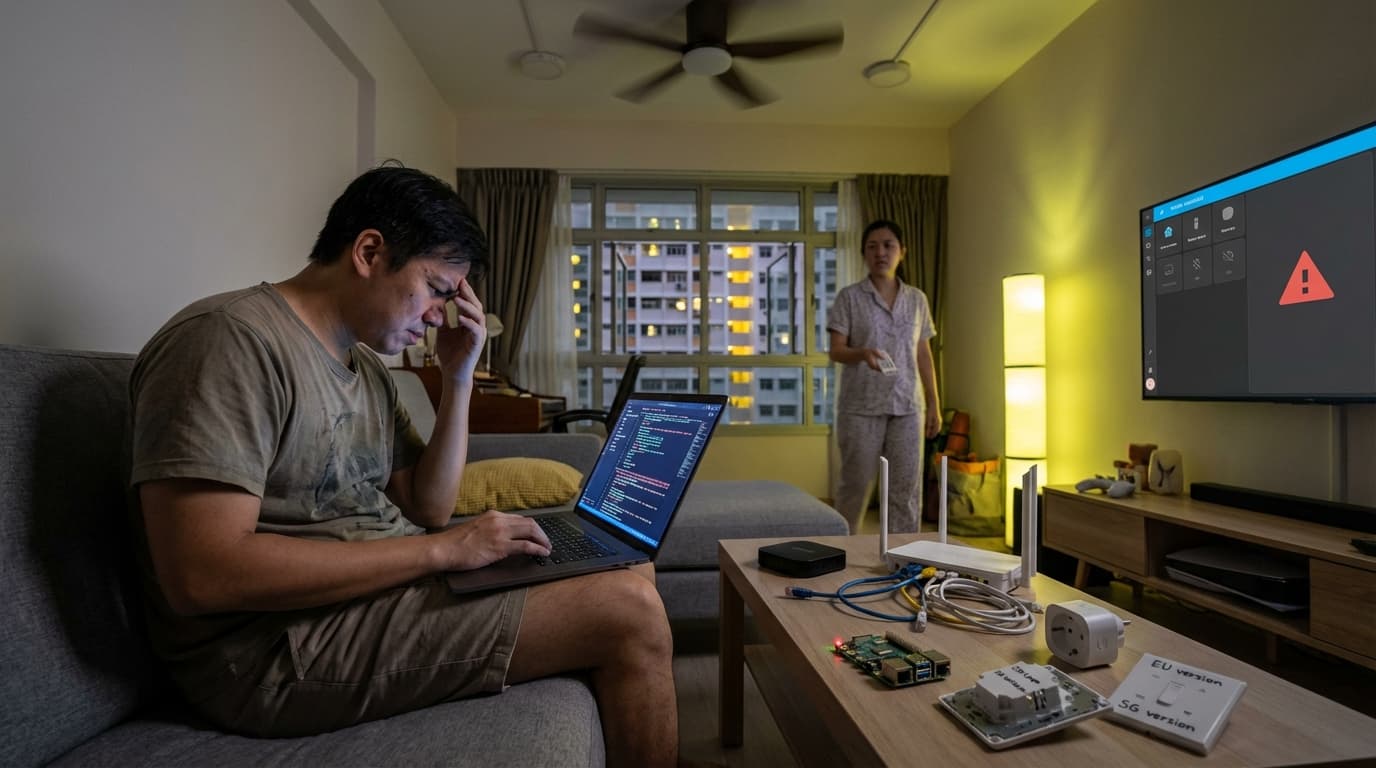
The Hidden Costs of Total Control: Why Home Assistant Isn't for Everyone

In the world of smart home automation, Home Assistant is often hailed as the "holy grail." It is open-source, runs locally, respects your privacy, and boasts a library of over 2,500 integrations. For enthusiasts and power users, it is the undisputed champion of home control.
However, at Layman Smart Home, we believe in providing balanced advice to Singapore homeowners. While we love the power of Home Assistant, it is not a "plug-and-play" solution like a simple Google Home or Apple HomeKit setup. For many, the road to a truly autonomous home is paved with unexpected hurdles.
If you are considering a smart home conversion in your HDB, condo, or landed property, it is crucial to understand the cons of Home Assistant before you commit. Here is a deep dive into the challenges you might face.
Quick Answer
- Home Assistant is powerful but not plug-and-play. Expect hardware compatibility gaps, a real learning curve (YAML, entities, troubleshooting), and frequent monthly updates that can introduce breaking changes.
- If self-hosted, you're also responsible for the server hardware, backups, and power recovery — there's no vendor support line to call.
- A failed automation creates "tech friction" for the whole household, not just you.
- Professional integration addresses most of this by using only tested hardware, managing updates, and building dashboards that hide the complexity.
1. The "Integration Lottery": Hardware Uncertainty
The single biggest challenge with Home Assistant is the sheer scale of the global smart home market. There are tens of thousands of brands—from giant multinationals like Sony and Samsung to obscure OEM manufacturers on AliExpress.
The Compatibility Gap
While Home Assistant can talk to almost anything, that doesn't mean it will talk to everything right out of the box.
- Firmware Lockouts: Manufacturers frequently update their device firmware to block third-party access. A smart plug that worked perfectly yesterday might become a "dumb" brick tomorrow because the manufacturer decided to close their API.
- Regional Variations: A Zigbee switch bought from a retailer in Europe might have different clusters or attributes than the same model sold in Singapore.
- The "Wait and See" Game: When a new, groundbreaking product is released (like a high-end robot vacuum or a new series of smart blinds), it can take months for the open-source community to develop a stable integration for it.
- Product Quality Roulette: Not all "smart" devices are created equal. Some manufacturers prioritise cost-cutting over reliability, using cheap chips or unstable components that cause frequent disconnections or erratic behaviour. Worse, some brands simply don’t expose the functionalities of their products, making it impossible for Home Assistant to access critical functions—even if the hardware is technically capable.
For a homeowner, this creates a sense of hardware uncertainty. You cannot simply walk into a hardware store, buy a random "smart" device, and assume it will work with your automations. It requires constant research and verification.
2. The Steep Learning Curve
Home Assistant has come a long way in terms of user interface, but it still requires a level of technical literacy that many find daunting.
- YAML and Coding: While basic automations can be done via a visual editor, the "magic" of Home Assistant often requires editing YAML configuration files. If you miss a single space or a colon in a line of code, your entire system might fail to restart.
- Complex Terminology: Understanding the difference between an Entity, a Device, an Integration, and a Helper is a prerequisite for building a functional home.
- Troubleshooting: When an automation fails, you aren't just looking at a simple error message. You are often diving into "Logs" and "Traces" to find out which specific logic condition wasn't met. For the average user who just wants their lights to turn on, this can feel like a part-time job.
3. Maintenance and "Update Fatigue"
Unlike a proprietary system that updates silently in the background, Home Assistant is a living, breathing project. The developers release a major update every single month.
Breaking Changes
Because the platform moves so fast, updates often include "Breaking Changes." This means that the way a certain light or sensor worked in February might be fundamentally different in March.
- Manual Fixes: After an update, you may find that your favorite dashboard card is broken or your voice commands no longer work. You must then spend time reading through the "Release Notes" to find the fix.
- The Stability Trade-off: If you don't update, you miss out on security patches and new features. If you do update, you risk breaking a system that was working perfectly. For a busy Singaporean family, this "maintenance tax" can be a significant drain on time.
4. Hardware Responsibility (The DIY Burden)
If you set up Home Assistant on your own, you are the IT department.
- The Server: You have to provide the hardware to run it—be it a Raspberry Pi, an Intel NUC, or a dedicated Home Assistant Green. If that hardware fails, or if your SD card becomes corrupted (a common issue with Raspberry Pis), your entire home goes offline.
- Backups: You are responsible for managing your own backups. If you haven't set up an automated backup to Google Drive or a NAS, one hardware failure could mean losing months of complex automation work.
- Power Management: In the event of a power surge or a brief outage, you need to ensure your server restarts correctly and reconnects to all your Zigbee and Z-Wave networks.
5. The "Spouse/Family Approval Factor"
A smart home is only successful if everyone in the house can use it.
Because Home Assistant is so customizable, it is easy to over-engineer things. If the "smart" lights don't turn on because of a logic error in your code, your family members will quickly lose patience. Unlike a standard switch, a failed smart home creates "tech friction" in the household.
If you are the only one who knows how to "fix the house," you become the permanent on-call support for your family—even when you are at work or overseas.
Conclusion: Is Home Assistant Right for You?
Despite these cons, Home Assistant remains the most powerful tool for creating a truly local, private, and powerful smart home. The key is how you implement it.
This is where Layman Smart Home comes in. We bridge the gap between "technical complexity" and "layman simplicity."
- We handle the hardware uncertainty by only installing tried-and-tested products that we know are stable with Home Assistant.
- We manage the setup and updates, providing you with a system that is robust and "family-proof."
- We design clean, intuitive dashboards so you never have to see a single line of YAML code unless you want to.
A smart home should serve you, not the other way around. If you want the power of Home Assistant without the steep learning curve or the maintenance headaches, let us handle the integration for you.
Explore our professional integration services.
For more context on why local-first setups matter, read our local control guide, and if you’re still comparing options, this platform comparison guide helps you decide.
FAQ
Is Home Assistant reliable enough for my home?
Yes, but reliability depends heavily on using tested, compatible hardware and a proper setup, not just plugging in any "smart" device you find.
Do I need to know how to code to use Home Assistant?
Basic automations can be done with a visual editor, but more advanced setups might require editing YAML configuration files, which has a real learning curve, but this has been improving over the years.
What happens when Home Assistant releases an update?
Updates ship roughly monthly and may include breaking changes that affect your home, so do read release notes and make manual fixes, or you can leave it as it is until you want a new feature.
What's the biggest risk of running it yourself?
You become the household's IT department, responsible for the server, backups, and being the only person who can "fix the house" when something breaks.
Want Home Assistant without the hassle?
We handle the setup and maintenance so you do not have to.