
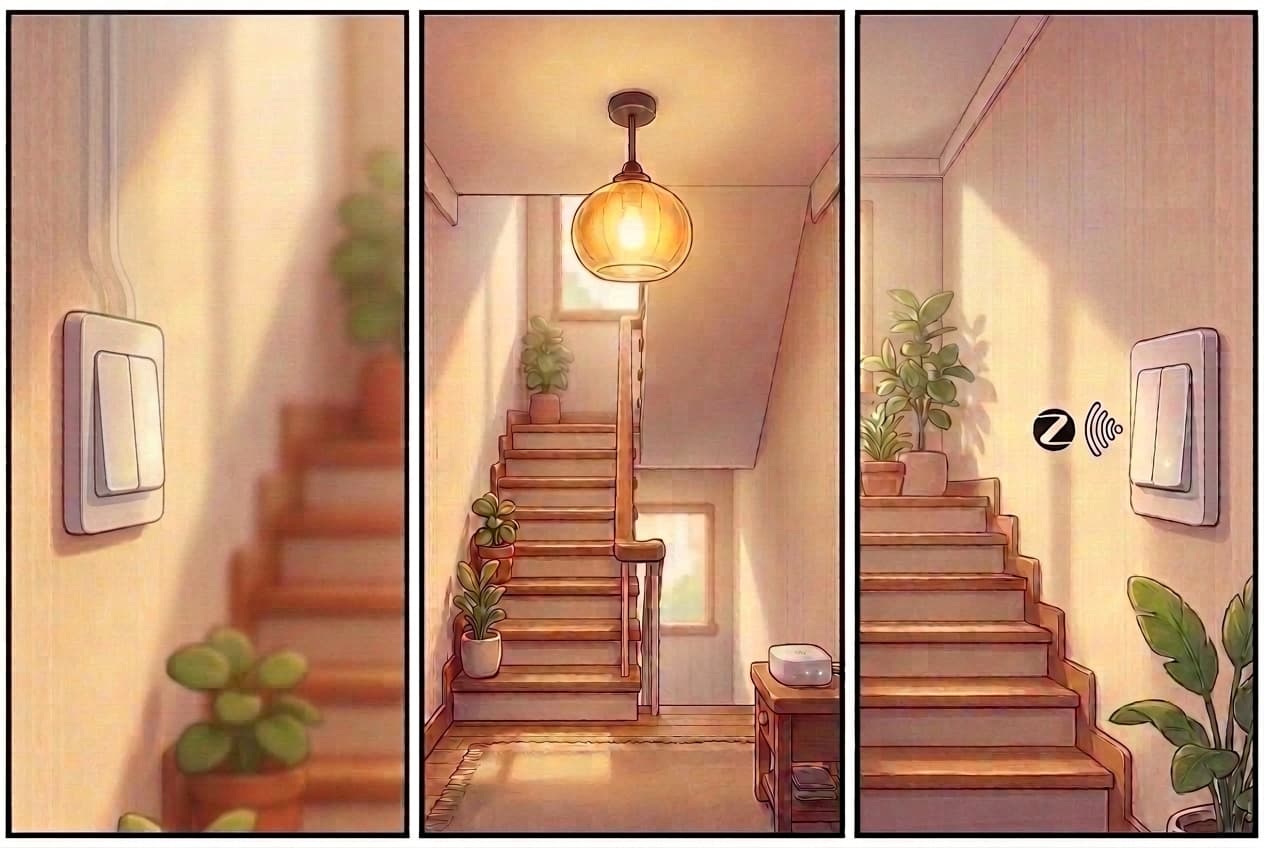
This Is the Way (to Fix Your 2-Way Switch)

If you've read our guide on neutral vs no-neutral wiring, you know the usual drill: check if there's a neutral wire at the switch box, pick your switch type, done. Then you get to a staircase landing, or a long corridor with a switch at each end, and the usual drill stops applying. This is one of the most common "wait, why won't this work" moments we run into on site, usually after the homeowner has already bought the switches.
Two-way switching quietly breaks a lot of assumptions that hold for a normal single-point switch. Here's what's actually happening, and the three fixes we propose to sort it out without tearing the house apart.
Quick Answer
- Two-way switches (one light controlled from two locations, common at staircase landings, in HDB maisonettes, and in landed homes) use traveler wiring, and standard no-neutral smart switches aren't built for that circuit shape.
- We propose three field-tested fixes to your electrician, none of which require rewiring the house: cross-wire each light to one gang and decouple the other in software, move control to a relay module at the ceiling rose (we specify Shelly, Sonoff, or Aqara modules for this), or cap the second switch and replace it with a wireless battery companion switch.
- The ceiling rose relay method also fixes the usual no-neutral "ghost flickering" problem, since the module draws real neutral from the light point instead of leaking current through the bulb.
- This isn't a DIY job. Traveler wires stay live in ways that aren't obvious, and getting the termination wrong can cause a dead short. This is work for your licensed electrician, and we brief them on the exact spec.
Two-Way Switches Are Everywhere, and Nobody Warns You About Them
We've run into two-way wiring at staircase landings in pretty much every property type: HDB maisonettes, landed homes, condos with split-level layouts. Anywhere a light needs to be switched from both the top and bottom of a flight of stairs, you're looking at a two-way circuit.
For anyone who hasn't met the term before: two-way switching means one light is controlled by two separate switches, and either one can turn it on or off regardless of what the other switch is currently set to. Flip the switch downstairs to turn the landing light on, flip the switch upstairs to turn it off. Simple enough with a mechanical switch. Less simple once you try to swap either one for a smart switch.
Why Your No-Neutral Smart Switch Doesn't Like Two-Way Circuits
A normal single-point switch circuit is straightforward: live wire in, live wire out to the bulb, and the switch is a gate sitting in between. A no-neutral smart switch survives in that setup by leaking a small trickle of current through the bulb to stay powered, which is the whole trade-off we cover in our neutral vs no-neutral guide.
A two-way circuit doesn't give you a clean live-in, live-out-to-load pair at either switch box. Instead, the two switches are connected by traveler wires, and which traveler is actually carrying live current depends on the position of the other switch. Neither box has a fixed relationship with the load.
Put a standard no-neutral smart switch into one of the two positions and leave the original mechanical switch in the other, and you'll hit one of two problems. Either the mechanical switch flips the traveler in a way the smart switch's relay never sees, so your app says the light is off while it's actually on, or the smart switch's leak-to-stay-alive trick stops working reliably and you get flicker on top of a switch that doesn't respond properly. Neither is something you want to explain to a client after installation.
Method 1: Cross-Wire the Load, Decouple the Rest
This is what we propose most often for the common case: a two-way circuit using multi-gang switches at both ends, where each gang is normally paired up for a separate light. Say a staircase landing has a 2-gang switch at the top and a 2-gang switch at the bottom. Light A runs two-way between Gang A on Switch 1 and Gang A on Switch 2. Light B runs two-way between Gang B on Switch 1 and Gang B on Switch 2, paired the opposite way so both switches keep two working buttons.
Here's the spec we hand to the electrician:
- Wire Light A physically to Switch 1's Gang A only. That gang becomes a normal single-point smart switch: live in, live out to the bulb, no travelers involved.
- Terminate (cap off) Switch 2's Gang A leg. It no longer carries any load.
- Mirror this for Light B in the other direction: wire it physically to Switch 2's Gang B only, and terminate Switch 1's Gang B leg.
- Both switch boxes need to be proper multi-gang smart switches for this to work. One smart switch plus one leftover mechanical switch won't do it.
- The two gangs that just got terminated (Switch 1's Gang B, Switch 2's Gang A) still draw power through their own live-in feed, so they can still register a button press even with nothing wired to their output. In the smart home software, we set those two gangs to a decoupled or input-only mode, then write a simple automation: pressing Switch 1's Gang B toggles Switch 2's Gang B (the one actually wired to Light B), and pressing Switch 2's Gang A toggles Switch 1's Gang A (wired to Light A).
Every gang on the wall still does something when you press it, and both lights are still controllable from both ends. Electrically, each light only ever has one real relay driving it, so there's no traveler confusion and no two switches fighting over the same leak-to-stay-alive trick. No new cable runs needed either. It's re-termination of what's already in the wall, plus an automation.
Method 2: Move the Brain to the Ceiling Rose
If the gangs don't line up neatly for Method 1, say it's a single-gang two-way switch, or you'd rather not put two full smart switch panels at both ends, we propose going up to the ceiling rose instead. Most light points already have neutral running to them even when the switch boxes downstream don't, since the neutral usually completes the circuit back at the light fixture itself.
A relay module sits at the ceiling rose and does the actual switching. We specify Shelly, Sonoff, or Aqara modules for this depending on the job. The electrician re-terminates both wall switches as dry-contact triggers into the module, using wiring that's already there. This solves two problems at once. The relay draws real neutral, so it doesn't need the leak-to-stay-alive trick, which means no ghost flickering either. And since the module is just reading "was a switch pressed," it handles two-way logic natively regardless of how many switches feed into it.
Method 3: Cap It and Go Wireless
The lightest-touch option. Leave one of the two switch positions as the real smart switch, wired normally. At the second position, terminate the travelers entirely so that switch stops being part of the electrical circuit, and mount a battery-powered wireless scene switch or remote in its place, paired to the smart hub. Press it, and it sends a command to toggle the real switch, the same way pressing a button in the app would.
We've suggested this plenty of times too, usually when a client doesn't want their electrician opening up the second switch box beyond capping the wires. The trade-off is that the second position isn't truly hardwired anymore, it's a battery accessory sitting in the same spot, and someone has to remember to swap the battery every so often.
Which Method Should You Use?
- Multi-gang two-way circuit, and you want both ends to stay "real" smart switches: Method 1.
- Single-gang two-way, or you'd rather deal with one relay module than two full switch panels, or you're already fighting ghost flickering: Method 2.
- You want the lightest possible touch inside the switch boxes: Method 3.
We usually confirm which one fits during a site visit, then hand the spec over to your electrician to execute, since gang count and what's already run between the switch boxes and the ceiling rose both affect which option makes sense.
This Is a Job for Your Electrician
Traveler wires can stay live in ways that aren't obvious just from looking at a switch that's flipped "off," because current can still be present on the other traveler leg depending on the second switch's position. Get a termination wrong and you can bridge live to load and cause a dead short, or leave a wire live when someone assumes it's safe to touch. We propose the fix and the wiring spec, but the physical work of opening up switch boxes and re-terminating live wires is always for a licensed electrician, whether that's your own or one we coordinate with.
FAQ
What's the difference between a two-way switch and a normal switch?
A normal switch controls a light from one location. A two-way switch setup controls a single light from two separate switch locations, common at staircase landings, where either switch can turn the light on or off regardless of the other switch's position.
Can I just buy a no-neutral smart switch that supports two-way wiring properly?
We haven't come across a no-neutral smart switch model with genuine two-way (traveler) support that we'd trust in the field. That's why we propose one of three retrofit methods instead of relying on the switch hardware alone.
Will the cross-wire and decouple method work with single-gang two-way switches?
No. That method needs at least two gangs per switch box, one to carry the real load and one to act as the decoupled trigger. Single-gang two-way circuits are better suited to the ceiling rose relay method or a wireless companion switch.
Does the ceiling rose relay method require rewiring the house?
No. It reuses the existing wiring between the switch boxes and the light point, re-terminated as dry contacts into the relay module. No new cable runs are needed.
Can I do this myself?
No. Traveler wires can stay live in non-obvious ways, and incorrect termination can cause a dead short. This should always be done by a licensed electrician, working off a clear spec for which method applies to your circuit.
This is the way. Well, one of three ways, but you get the idea.

Got a two-way switch that's not playing nice?
We assess your existing wiring and tell you which fix actually applies to your home.
Get your two-way switch retrofit assessed