
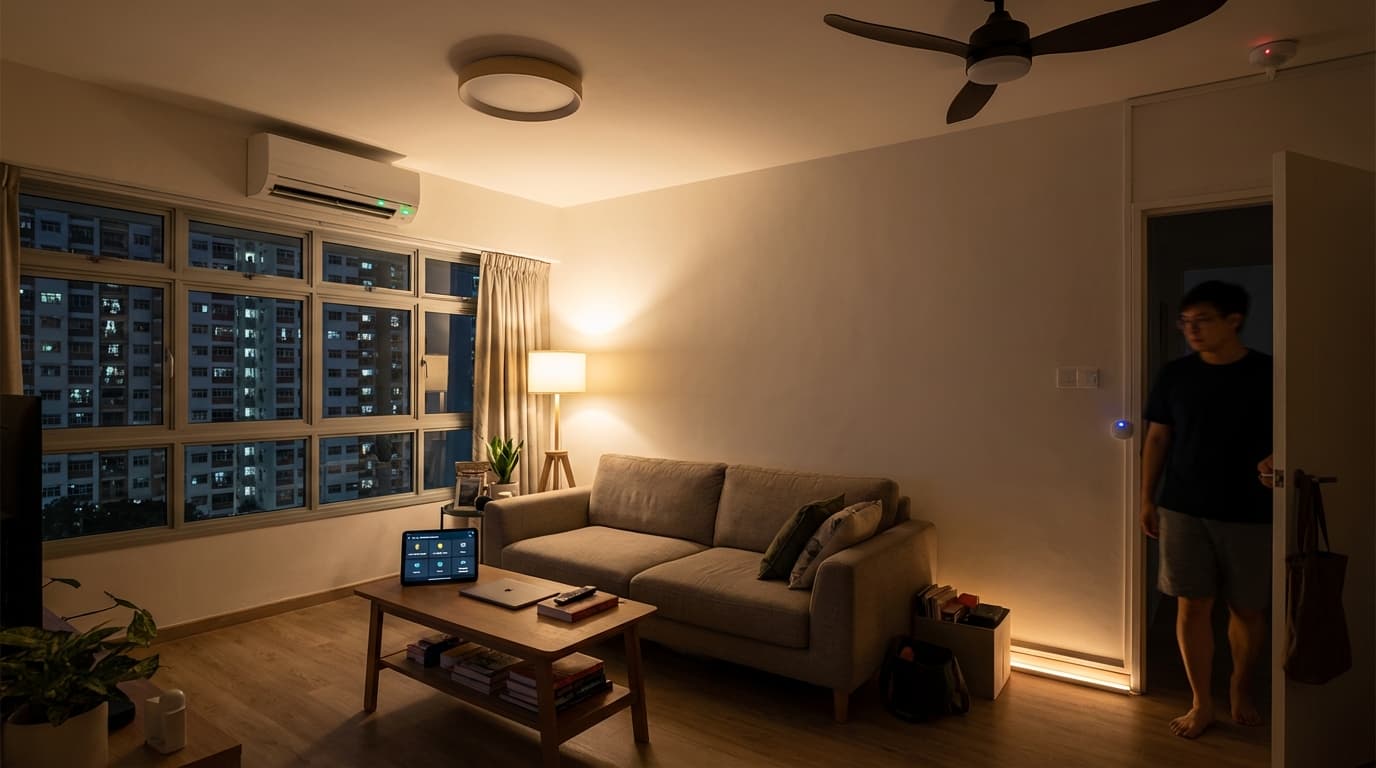
The Ultimate Guide to Presence Sensors: Achieving True Automation in Your Singapore Smart Home

Imagine walking into your living room in your Sembawang HDB or Queenstown condo, and the lights transition to a warm glow, the air-con hums to life, and your favorite playlist begins to play—all without you touching a single switch or uttering a voice command. When you sit on the sofa to read, the lights stay on perfectly. When you leave for the kitchen, they dim behind you.
This is the promise of True Presence-Based Automation.
At Layman Smart Home, we often tell our clients that motion sensors are for security, but presence sensors are for living. However, moving from simple motion detection to high-fidelity presence sensing is one of the most technically challenging aspects of a Home Assistant setup.
In this comprehensive guide, we will dive deep into the world of mmWave technology, the pros and cons of presence sensors, and the "invisible" variables—like ceiling fans—that can make or break your automation.
Quick Answer
- mmWave presence sensors detect micro-movements (like breathing) so lights stay on while you're still, unlike PIR motion sensors that "lose" you if you sit still.
- They cost more and need constant USB or hardwired power (unlike PIR's 2-year coin battery), so plan electrical points during renovation.
- The biggest challenge is false positives — ceiling fans, fluttering curtains, and "wall-piercing" detection through thin walls all need careful calibration (energy thresholds, sensitivity delays, distance gates).
- The "gold standard" setup pairs a PIR sensor (instant "on") with an mmWave sensor (accurate "stay on") for the best of both.
1. Motion vs. Presence: Understanding the Technology
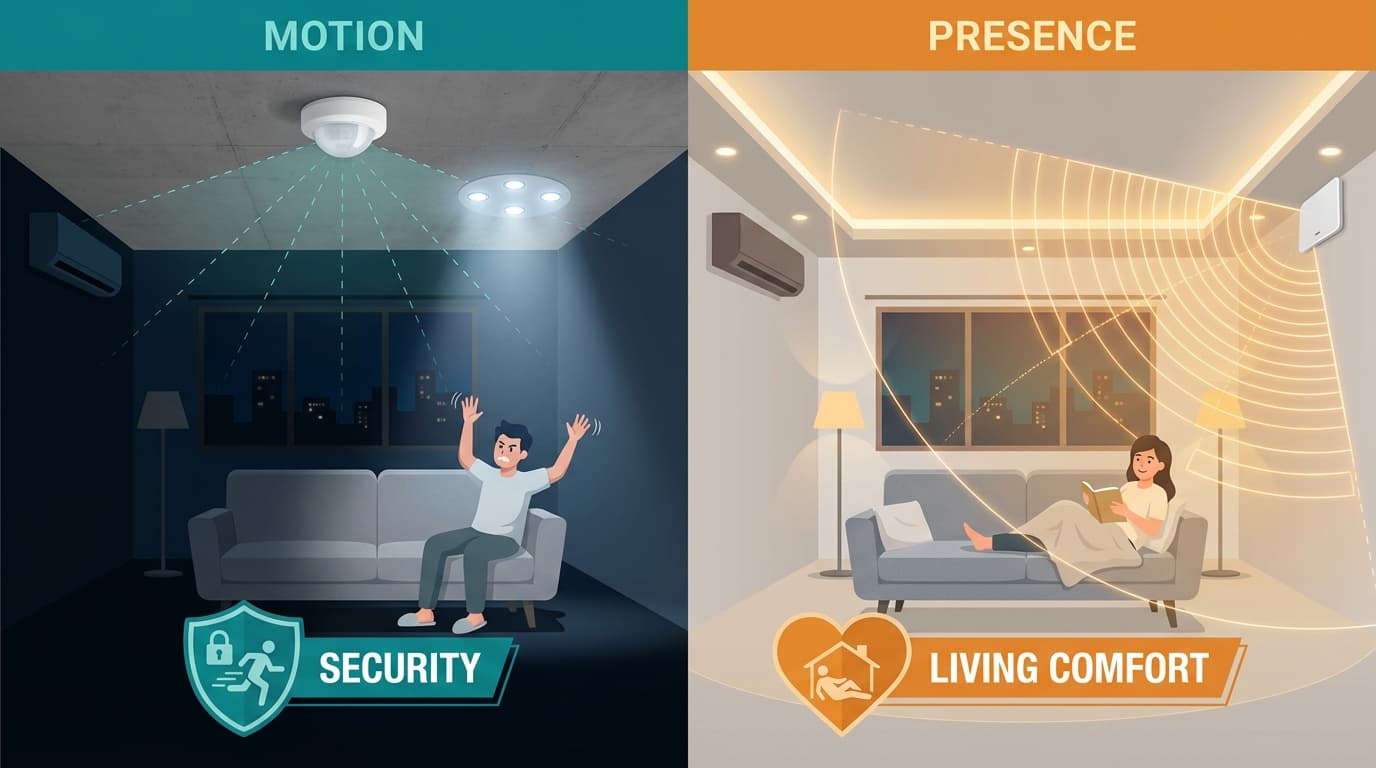
To build a smart home that feels "magical," you must first understand the difference between the two primary types of occupancy sensing.
Passive Infrared (PIR) Motion Sensors
Standard motion sensors (PIR) work by detecting changes in infrared radiation—essentially, heat in motion.
- The Limitation: If you sit still on the sofa watching Netflix or working at your desk, the sensor "loses" you. This leads to the frustrating "arm-waving" dance just to get the lights to turn back on.
mmWave Presence Sensors
Modern presence sensors use Millimeter Wave (mmWave) radar technology. These sensors emit low-power radio waves that bounce off objects and return to the sensor.
- The Breakthrough: mmWave is sensitive enough to detect "micro-movements," such as the rise and fall of your chest while breathing or the slight shift of your head while reading. As long as you are in the room, the sensor knows you are there.
2. The Pros of Using Presence Sensors
Total "Hands-Free" Living
Presence sensors remove the need for voice commands or app control. In a 5-storey strata unit or a sprawling 4-bedroom resale flat, the convenience of the house "knowing" where you are is unparalleled.
Energy Efficiency and Cost Savings
In Singapore, air-conditioning is the biggest drain on our electricity bills. Presence sensors allow for aggressive energy-saving automations. If a room is unoccupied for more than 10 minutes, Home Assistant can shut down the AC and lights, ensuring you aren't cooling an empty room.
Enhanced Safety for Seniors
For families with elderly members, presence sensors are a non-intrusive safety net. They can detect a "fall" or prolonged immovability in high-risk areas like the bathroom, triggering an immediate notification to the rest of the family without the need for wearable panic buttons.
3. The Cons and Challenges of Presence Sensing
While the technology is revolutionary, it is not "plug-and-play."
The Cost of Entry
High-quality mmWave sensors (like the Aqara FP2 or specialized Home Assistant-native ESPHome sensors) are significantly more expensive than basic PIR sensors. A typical smart home might need 5 to 10 of these to cover all major zones.
Power Requirements
Unlike PIR sensors that can run on a coin battery for two years, mmWave sensors are power-hungry. They almost always require a constant USB power supply or a hardwired connection. This means you need to plan your electrical points carefully during your renovation.
Complexity of Calibration
A presence sensor sees everything. Without proper calibration, it can be "too smart" for its own good.
4. The "Ghost in the Machine": Dealing with False Positives
The biggest difficulty in setting up presence sensors in a Singaporean home is managing uncontrollable variables. mmWave radar can see through thin walls, glass, and even detect movements from inanimate objects.
The Ceiling Fan Dilemma
In Singapore, the ceiling fan is a staple. To an mmWave sensor, a spinning fan looks like a human constantly moving in a circle.
- The Result: The lights will never turn off because the sensor thinks someone is always in the room.
- The Solution: Professional-grade sensors like the ones we use at Layman Smart Home allow for “Energy Tweaking". We can adjust the energy thresholds detected by the mmWave radar, teaching the sensor to distinguish between "what is a person" and "what is a device like a spinning fan blade," effectively ignoring motion in that specific 3D space.
Curtains and Air-Con Vents
A light breeze from an air-con unit can cause a curtain to flutter. To a sensitive presence sensor, that fluttering curtain is a "person."
- The Fix: This requires fine-tuning the sensitivity thresholds within Home Assistant. We often set a "detection delay" where the sensor must detect movement for at least 2-3 seconds before triggering an "occupied" state, filtering out momentary environmental movements.
The "Wall-Piercing" Effect
mmWave can sometimes detect a person walking in the corridor outside the room through a thin drywall or glass partition.
- The Fix: We use "Distance Gate" settings to limit the sensor's reach. If your room is 4 meters deep, we set the sensor to ignore anything beyond 4.2 meters.
5. Guide to a Successful Presence Sensor Setup
If you are planning to integrate presence sensing into your renovation, follow this strategic approach:
Step 1: Strategic Placement
Avoid placing sensors directly opposite mirrors or large metallic surfaces, as these can cause "multipath interference" where the radar waves bounce around and create ghost targets. The ideal placement is usually in a corner, 2.1 meters high, tilted slightly downward.
Step 2: Zone Mapping
Divide your room into functional zones in your dashboard:
- Zone A: The Sofa (for Movie Mode)
- Zone B: The Dining Table (for Dinner Mode)
- Zone C: The Entrance (for Triggering Entry)
Step 3: Layering Sensors (The "Gold Standard")
For the most reliable results, we use a Multi-Sensor Approach. We pair a PIR sensor (for instant "On" when you enter) with an mmWave sensor (for "Stay On" while you are still). This hybrid approach provides the speed of infrared with the accuracy of radar.
6. Why Professional Integration Matters
Achieving a 0% false-positive rate is an art form. It involves hours of monitoring "Logs" and "Traces" in Home Assistant to see exactly what triggered a light at 3 AM.
At Layman Smart Home, we specialize in the "Dark Arts" of presence sensing. We help our clients:
- Plan Electrical Points: Ensuring your sensors have hidden, constant power.
- Filter Environmental Noise: Calibrating your system to ignore fans, robotic vacuums, and pets.
- Build Natural Automations: Ensuring the lights don't just "turn on," but fade in and out gracefully based on your presence.
A smart home shouldn't just be a collection of gadgets; it should be an invisible assistant that knows where you are and what you need.
FAQ
Why do my lights keep staying on even when no one's in the room?
A spinning ceiling fan can look like constant human movement to an mmWave sensor. This is fixed by adjusting the energy thresholds so the sensor learns to ignore that specific motion pattern.
Do presence sensors need batteries like motion sensors?
No. Unlike PIR sensors that can run on a coin battery for two years, mmWave sensors are power-hungry and almost always need constant USB or hardwired power.
Can a presence sensor detect someone outside my room by mistake?
Yes. mmWave can sometimes detect movement through thin drywall or glass from an adjacent corridor. This is fixed using "Distance Gate" settings to limit the sensor's effective range.
What's the most reliable presence sensor setup?
A hybrid "layered" approach: pairing a PIR sensor for instant "on" detection with an mmWave sensor for accurate "stay on" tracking while you're still present.
Ready for true presence-based automation?
We design sensor setups that make your home respond to you naturally.