
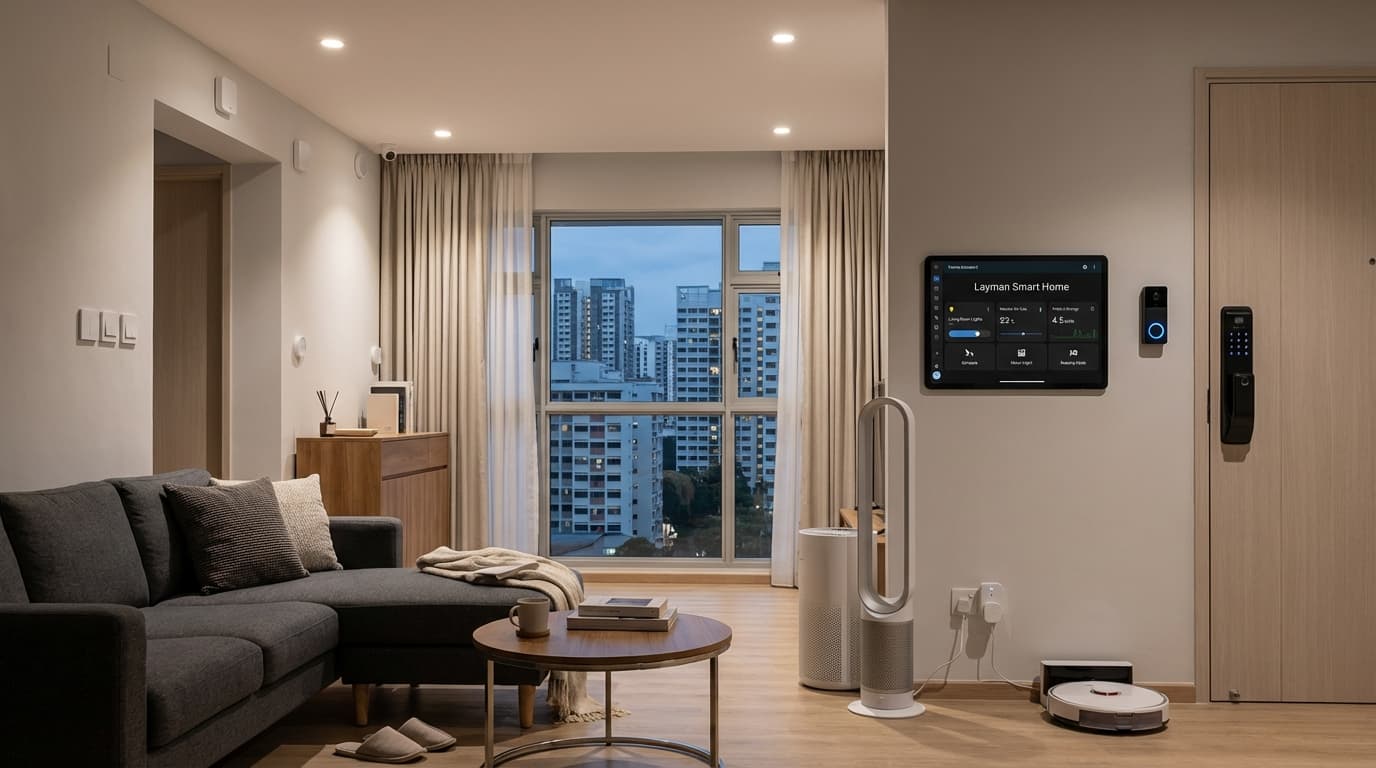
Top 10 Smart Home Devices to Make Your Life in Singapore Easier (2026 Guide)

Singapore is one of the most technologically advanced nations in the world. As our urban landscape evolves, so do our living spaces. Whether you are moving into a brand-new BTO in Tengah, upgrading a resale HDB in Queenstown, or retrofitting a sleek condominium in Bukit Timah, smart home technology is no longer a futuristic concept—it is a modern daily necessity.
In Singapore's fast-paced environment, automation translates directly into reclaimed time, enhanced security, and lower SP Group utility bills. However, buying a bunch of disparate Wi-Fi gadgets often leads to "app fatigue" and network instability.
The secret to a seamless experience is centralizing your devices using Home Assistant. By shifting processing away from unstable overseas clouds and into a local, unified hub, your devices talk to each other instantly.
Here are the Top 10 smart home devices that will make your life in Singapore easier, the rationale behind why you need them, and how they integrate beautifully into Home Assistant.
Quick Answer
- Top 10 devices: Zigbee wall switches, mmWave presence sensors, digital door locks, air-con control modules, motorized curtains, smart water heater switches, video doorbells, robot vacuums, energy-monitoring smart plugs, and temperature/humidity sensors.
- Centralizing everything through Home Assistant avoids "app fatigue" from juggling separate apps per brand and keeps processing local instead of routing through unstable overseas clouds.
- Air-con accounts for 40–60% of a typical Singapore electricity bill, making smart air-con control modules and presence-based automation some of the highest-impact upgrades.
- Most of these devices integrate via Zigbee, Z-Wave, or local NVR (for cameras), letting Home Assistant trigger automations across brands instantly.
1. Smart Zigbee Wall Switches (Neutral & No-Neutral)
If you can only upgrade one thing in your house, let it be your light switches. Traditional smart bulbs lose their "smartness" the moment someone manually flips the wall switch off. Smart switches replace the physical mechanism at the wall, ensuring your lights are always online and controllable.
- The Singapore Rationale: Many older resale HDB flats in Singapore do not have a neutral wire at the switch box. If you are doing a full renovation, we highly recommend pulling a full neutral wire setup for maximum stability. If you are doing a non-invasive conversion, high-quality no-neutral Zigbee switches are the perfect retrofit.
- Home Assistant Integration: When paired with Home Assistant via Zigbee (using Zigbee2MQTT or ZHA), these switches do more than turn lights on and off. You can program "Double Taps" or "Long Presses" to trigger scenes. For example, double-tapping the switch by the front door can trigger a global "Goodbye" mode, turning off every light and air-con in the house as you leave for work.
2. mmWave Human Presence Sensors
Standard Passive Infrared (PIR) motion sensors are great for security, but they are terrible for living. If you sit still on the sofa reading or watching a movie, a standard motion sensor "loses" you and plunges the room into darkness.
- The Singapore Rationale: Presence sensors utilize millimeter-wave (mmWave) radar technology. They are sensitive enough to detect micro-movements, such as the rise and fall of your chest as you breathe.
- Home Assistant Integration: In Home Assistant, presence sensors act as the ultimate automation trigger. You can zone your living room so that if Home Assistant detects you are sitting specifically on the sofa, it dims the lights to movie mode. If you fall asleep, it can automatically adjust the air-con temperature. It completely removes the need for physical switches or voice commands.
3. Smart Digital Door Locks
Fumbling for house keys while balancing heavy grocery bags from NTUC or Sheng Siong is a daily annoyance. A smart digital lock modernizes the entry point of your flat.
- The Singapore Rationale: In Singapore, digital locks with biometric fingerprints, PIN codes, or smartphone proximity trackers are standard. Beyond pure convenience, they offer peace of mind for families with elderly parents or school-going teenagers.
- Home Assistant Integration: By integrating your lock into Home Assistant (via Zigbee, Z-Wave, or Bluetooth), your front door becomes an automation trigger. When the parents' fingerprint unlocks the door between 6:00 PM and 8:00 PM, Home Assistant can disarm the security system, turn on the foyer lights, and broadcast a welcome home message over your smart speakers.
4. Smart Air-Con Control Modules (PCB-Level Integration)
Air-conditioning accounts for up to 40% to 60% of a typical Singaporean household's electricity bill. Managing the heat efficiently is the easiest way to lower your monthly expenses.
- The Singapore Rationale: You do not need to throw away perfectly good "dumb" air-cons. A smart air-con control module plugs directly into the PCB (printed circuit board) of your existing air-conditioner, giving you native, local control. Unlike IR blasters that simply mimic your remote, these modules communicate directly with the air-con's internal logic, allowing you to see the real-time state of the unit (on/off, temperature, mode, fan speed) and issue commands with zero lag.
- Home Assistant Integration: Home Assistant integrates these modules as native "Climate" entities with full state feedback. You can combine the module with a local temperature and humidity sensor. If Home Assistant detects the master bedroom has breached 28°C on a humid night, it triggers the air-con to turn on at your preferred settings. You can also automate the AC to turn off when geofencing detects that everyone has left the neighbourhood. Because the module reads the actual state of the air-con, Home Assistant always knows whether the unit is truly running, preventing ghost commands or out-of-sync automation.
Alternative: Smart IR Blasters (Air-Con Controllers)
- A smart Infrared (IR) blaster acts as a universal remote control. It bridges your traditional appliances to Home Assistant.
5. Motorized Curtains and Roller Blinds
Many Singapore apartments suffer from harsh morning sun or intense afternoon heat (especially west-facing units). Automated window treatments help maintain your home's thermal comfort.
- The Singapore Rationale: Motorized curtain tracks can block out thermal heat during the hottest parts of the afternoon (2:00 PM to 5:00 PM), passively cooling your home and reducing the workload on your air-conditioning.
- Home Assistant Integration: Instead of just opening and closing on a fixed timer, Home Assistant can open and close your curtains based on environmental conditions. It can track the position of the sun (azimuth and elevation) and tilt your blinds to let in natural light while blocking direct glare. In the morning, your curtains can open 10% every five minutes, acting as a natural, peaceful alarm clock.
6. Smart Water Heater Switches (High-Load Switches)
Water heaters (instant or storage tanks) are major electricity consumers in Singapore. Leaving a storage heater on 24/7 is a massive waste of money.
- The Singapore Rationale: A high-load 20A smart switch allows you to schedule your water heater.
- Home Assistant Integration: You can automate your water heater to turn on 20 minutes before your typical morning alarm and shut off automatically after 30 minutes. In Home Assistant, you can tie this to presence data: if the system detects that nobody has been home for 24 hours (e.g., you are on vacation), it overrides the schedule and keeps the heater off, saving you significant money on your utility bill.
7. Smart Video Doorbells
Home security in Singapore is less about crime prevention and more about convenience, parcel deliveries, and neighborhood awareness.
- The Singapore Rationale: With the boom of online shopping (Shopee, Lazada, Amazon), tracking deliveries at your doorstep is a daily routine. Smart doorbells let you see who is outside without getting up.
- Home Assistant Integration: Using local NVR (Network Video Recorder) integration like Frigate AI, Home Assistant can scan your doorbell camera feed entirely within your four walls (no cloud spying). It can distinguish between a delivery rider, a neighbor walking by, or a family member. If someone loiters at your door for more than 30 seconds without pressing the bell, Home Assistant can send a rich image notification to your phone.
8. Robot Vacuums and Mops
In Singapore's humid climate, dust and floor grime accumulate quickly. Sweeping and mopping daily is exhausting after a long day at work.
- The Singapore Rationale: Modern robotic vacuums empty their own dustbins, wash their own mop pads, and self-dry to prevent mildew.
- Home Assistant Integration: Standard manufacturer apps can be annoying because they demand you run the vacuum on a fixed schedule. In Home Assistant, you can create a "Clean While Away" automation. The robot vacuum only leaves its dock when Home Assistant detects that both partners' smartphones have left the home radius. You get clean floors daily, without ever hearing the vacuum run.
9. Smart Plugs with Energy Monitoring
Not every appliance needs to be smart from the factory. A standard standing fan, air purifier, or coffee machine can be modernized with a simple smart plug.
- The Singapore Rationale: Smart plugs with power monitoring are incredible tools for tracking your carbon footprint.
- Home Assistant Integration: Home Assistant has a dedicated Energy Dashboard. By plugging your washing machine into a smart plug, Home Assistant can track its power draw. When the cycle finishes and the wattage drops to zero, Home Assistant can push a Text-to-Speech (TTS) broadcast to your smart speakers: "The washing machine is done, please hang the clothes."
10. Smart Temperature and Humidity Sensors
Singapore's tropical humidity is a breeding ground for mold, particularly in wardrobes, shoe cabinets, and toilets.
- The Singapore Rationale: These tiny, inexpensive battery-powered sensors track real-time climate metrics.
- Home Assistant Integration: Place a sensor in your bathroom. When Home Assistant detects a sharp spike in humidity (meaning someone is showering), it automatically triggers the exhaust fan via a smart switch. Once the humidity drops back to normal levels, Home Assistant turns the fan off, keeping your bathroom dry and mold-free without human intervention.
Why Centralize with Layman Smart Home?
Buying these gadgets is only step one. The real magic happens when they are expertly calibrated to work together locally. Proprietary cloud ecosystems often lag, suffer server outages, or invade your privacy.
At Layman Smart Home, we bridge the gap. We specialize in Home Assistant integrations for Singaporean HDBs, condos, and landed properties. We help you with the electrical planning, device vetting, and dashboard design—giving you a fast, secure, and incredibly private smart home that just works.
Whether you want automated climate control, smart security, or beautiful lighting scenes, we remove the complexity so you can enjoy the convenience.
FAQ
What's the single highest-impact device to start with?
Smart Zigbee wall switches, since smart bulbs lose their "smartness" the moment someone flips the physical switch, while smart switches stay online and controllable 24/7.
Why use a smart air-con control module instead of an IR blaster?
A control module plugs into the air-con's PCB for native, zero-lag control and real-time state feedback, while an IR blaster just mimics your remote without knowing the unit's actual status.
Do I need a cloud account for these devices to work together?
No. Centralizing through Home Assistant lets devices from different brands talk to each other locally, avoiding cloud dependency, lag, and the "app fatigue" of juggling separate apps.
Can a video doorbell tell the difference between a delivery rider and a loiterer?
With local NVR integration like Frigate AI, Home Assistant can analyse the camera feed entirely within your home and distinguish between a delivery rider, a neighbour, or someone loitering.
Ready to simplify your daily routine?
We help you pick and set up devices that work together seamlessly.